
Percent Decrease: Definition, Method and Examples
To decrease a value by a percent, find that percent of the original value and subtract it, or multiply the original value by one minus the percent written as a decimal. In every calculation, the original value remains the base, representing one hundred percent.
Understanding percentages is essential for comparing values. A percent decrease compares the amount lost to the starting amount.
What is percent decrease?
A percent decrease is a measure of how much a quantity loses in value, expressed as a fraction of one hundred. It describes a reduction relative to the starting amount.
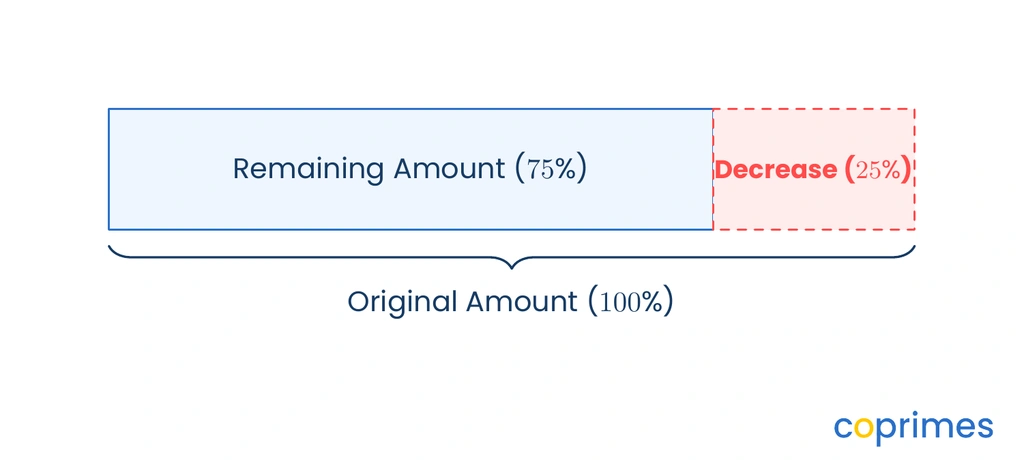
When an item goes on sale, its price decreases by a certain percentage. Calculating this involves finding a percent of a number and taking it away from the total.
Identify the original value
The original value is always the starting quantity before any reduction takes place. This starting amount represents the whole, or .
Recognizing the original value is the most important step because every percentage is calculated relative to this base. If the base is identified incorrectly, the final decreased amount will be wrong.
Subtract the decrease amount
One way to calculate a percent decrease is to find the actual amount of the decrease and subtract it from the original value.
- Convert the percentage to a decimal by dividing by .
- Multiply this decimal by the original value to find the amount of the decrease.
- Subtract the decrease amount from the original value.
For example, to decrease by , first find of . Since , the decrease is . Subtracting this from the original value gives .

Use a percent multiplier
A faster method uses a percent multiplier. Instead of finding the reduction and subtracting, calculate the percentage that remains and multiply it directly.
The multiplier is found by subtracting the percent decrease from one hundred percent and converting to a decimal.
- Subtract the percent decrease from .
- Convert the resulting percentage to a decimal.
- Multiply the original value by this decimal.
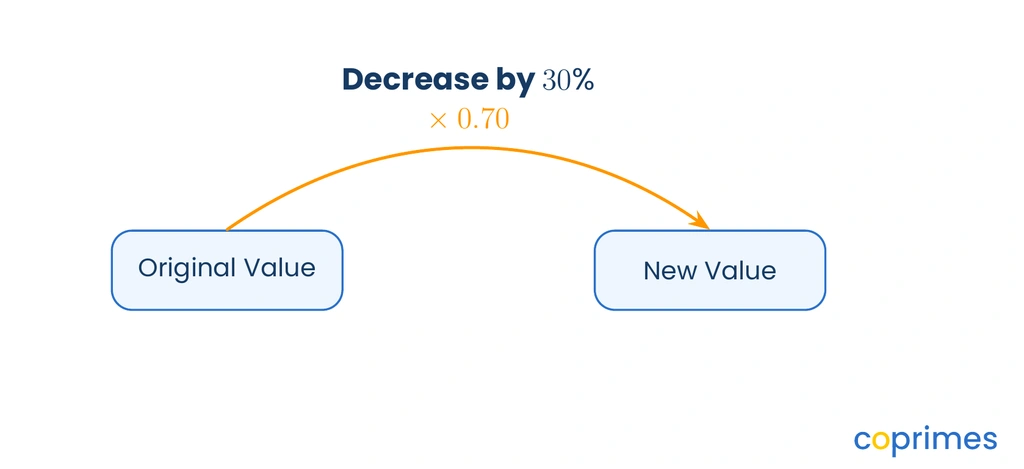
To decrease by , first subtract from to get . The multiplier is . Multiplying gives . Since the multiplier is less than one, the result correctly decreases.
Calculate percentage decrease between two values
When the original amount and the final reduced amount are known, the percentage decrease can be found using the percent decrease formula.
The percentage decrease is the difference between the two values divided by the original value, then converted to a percentage.
- Subtract the new value from the original value to find the absolute decrease.
- Divide the decrease by the original value.
- Multiply by to convert the decimal to a percentage.
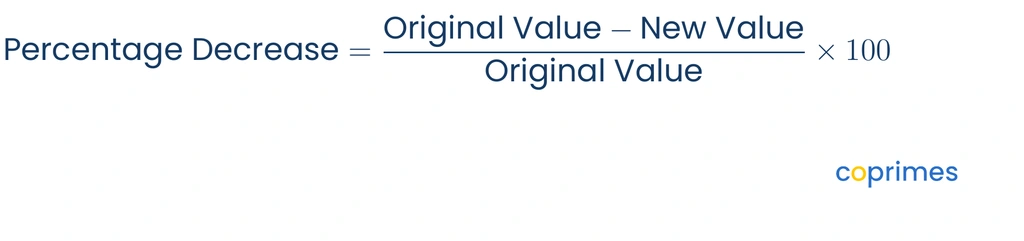
Always divide by the original value. Using the new value as the denominator is a common error that calculates the wrong percentage.
Worked examples
These examples show how to calculate percent decreases using both subtraction and multiplier methods, including situations such as retail discounts.
Example 1: Applying a percentage discount
Question: A tablet originally costs dollars. It is on sale with a decrease in price. What is the new price?
Method:
- Use the multiplier method by subtracting the percentage from . The remaining amount is .
- Convert to a decimal multiplier, which is .
- Multiply the original price by the multiplier: .
Answer: The new price is dollars.
Check: Find of , which is . Subtract from to get . The answers match.
Example 2: Decrease greater than fifty percent
Question: A water tank holding liters leaks until its volume decreases by . How much water is left in the tank?
Method:
- Find the percentage that remains: .
- Convert to a multiplier: .
- Multiply the original volume by the decimal: .
Answer: The tank has liters left.
Check: Since the decrease is more than half, the remaining amount should be less than half of , which is . The answer is reasonable.
Example 3: Working with a decimal percentage
Question: A digital file is compressed, decreasing its size of megabytes by . What is the new file size?
Method:
- Convert to a decimal by dividing by , which yields .
- Multiply to find the decrease amount: .
- Subtract the decrease from the original size: .
Answer: The new file size is megabytes.
Check: Using the multiplier method, . Multiplying yields .
A learning plan shaped by your child, not the class
State-aligned Math plus our own Logic and English curriculum. An adaptive baseline test finds the gaps and fills them.
Common mistakes
When working with percent decrease, avoid these common errors.
Dividing by the wrong base
When calculating the percentage decrease between two values, it is a mistake to divide by the new value instead of the original value. The starting value is always the reference point.
Adding instead of subtracting
Confusing a percent decrease with a percent increase causes the calculated amount to be added to the original value. A decrease must always be subtracted or multiplied by a decimal less than one.
Using the percent as a multiplier directly
Multiplying a value by to decrease it by finds the amount lost, not the final value. To find the final value in one step, the multiplier must be , which is .
Frequently asked questions
How is percent decrease different from percent change?
A percent change is a general term describing any relative difference, which can be an increase or a decrease. A percent decrease specifically means the final value is less than the original value.
Can a percent decrease be greater than one hundred percent?
No, a physical quantity cannot decrease by more than , because a decrease removes the entire original amount, leaving zero.
Why does a percent decrease followed by the same percent increase not return to the original value?
The base changes after the first operation. For example, decreasing by gives . Increasing by gives , not , because the increase is calculated on the smaller base of .
Practice questions
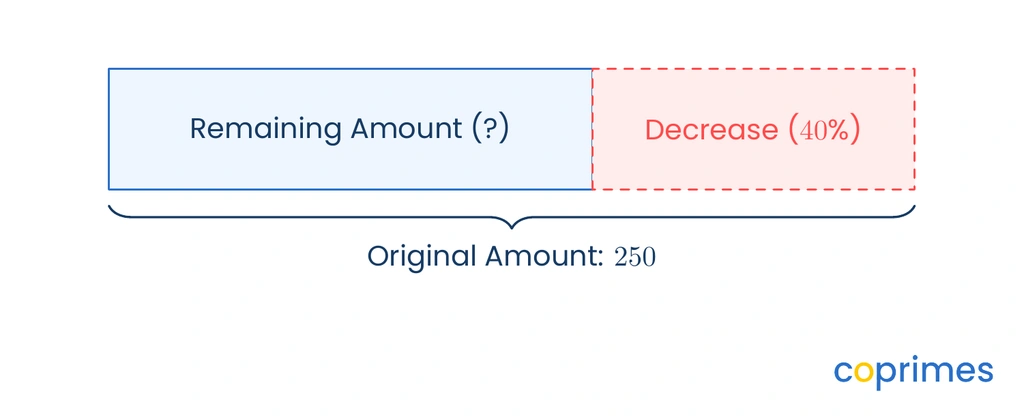
Based on the visual model, what is the value of the remaining amount when is decreased by ?
What is the decimal multiplier to decrease a value by ?
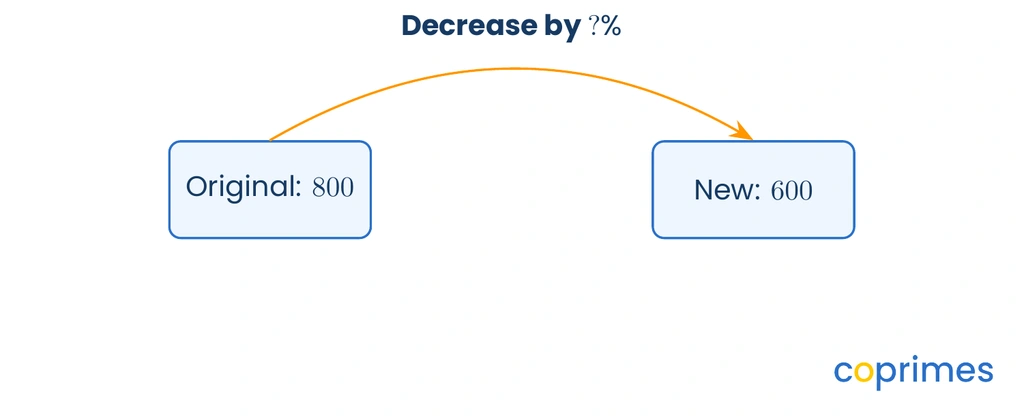
What is the percentage decrease from to ?
A car is driven for miles in the first year and miles in the second year. What is the percentage decrease in miles driven?
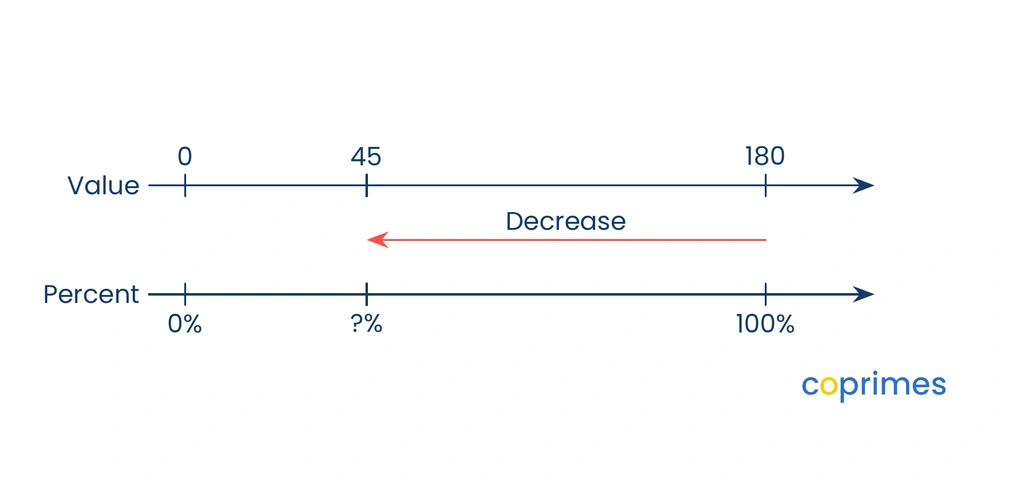
An item originally costs dollars and is reduced by dollars. Based on the number line, what is the percentage decrease?