
Percent Increase: Definition, Methods, and Examples
To increase a value by a percent, find that percent of the original value and add it, or multiply the original value by one plus the percent written as a decimal; the original value is always the base.
Percent increase calculations are essential for understanding markups, profit margins, and population growth.
What is percent increase?
Percent increase is the mathematical process of adding a specific percentages of a value onto that original amount.
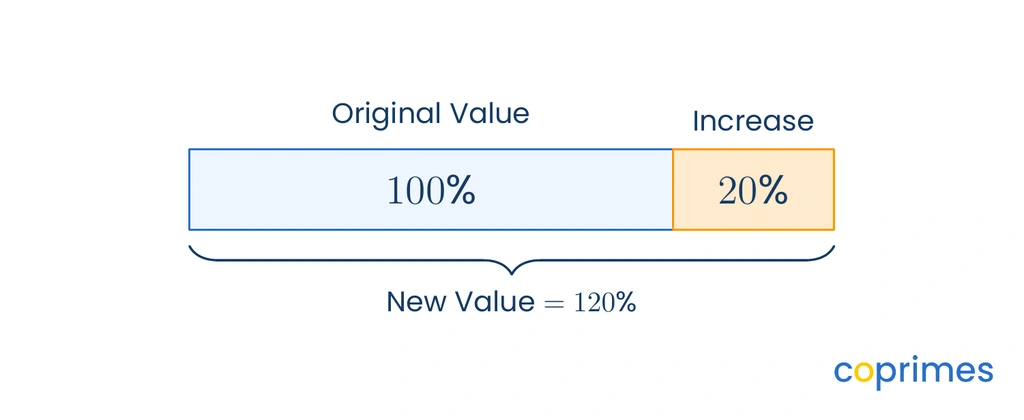
This results in a final value that is greater than the starting number. When dealing with percent increase, the original value always represents exactly .
Identify the original value
The most important step when you calculate percent increase is correctly identifying the original value.
The original value is the starting amount before any changes occur. Because all percent changes are measured relative to this starting point, the original value is always the mathematical base and is strictly equivalent to .
The original starting amount is always the mathematical base for any percentage calculation.
Add the increase amount
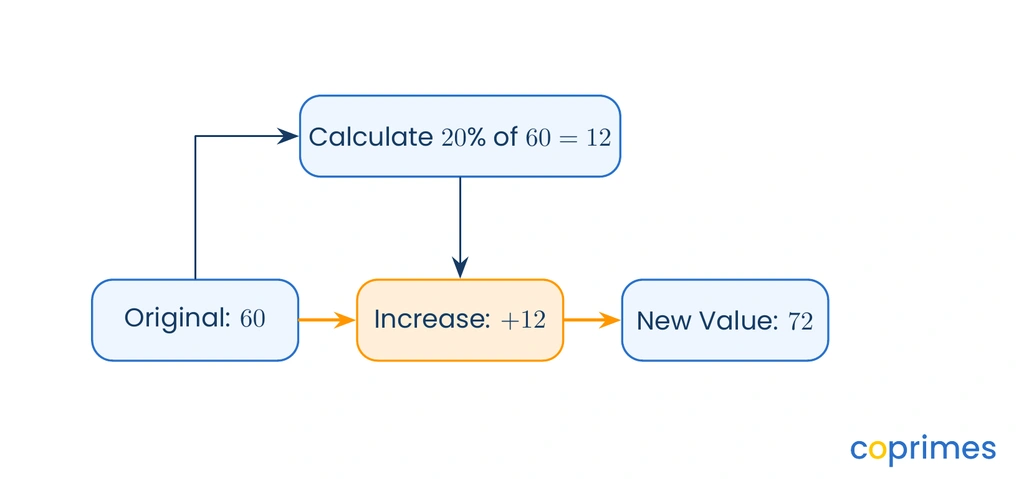
One straightforward method to increase by a percentage is to calculate the increase amount first, then add it to the starting number.
This requires you to calculate a percent of a number and apply the result.
To find the new value using this method:
- Identify the starting value and the percentage increase.
- Calculate the stated percentage of the original value.
- Add this computed increase amount to the original value.
A learning plan shaped by your child, not the class
State-aligned Math plus our own Logic and English curriculum. An adaptive baseline test finds the gaps and fills them.
Use a percent multiplier
A more efficient method is to use a decimal multiplier. Instead of finding the increase and adding it in two steps, you scale the original value in one calculation.
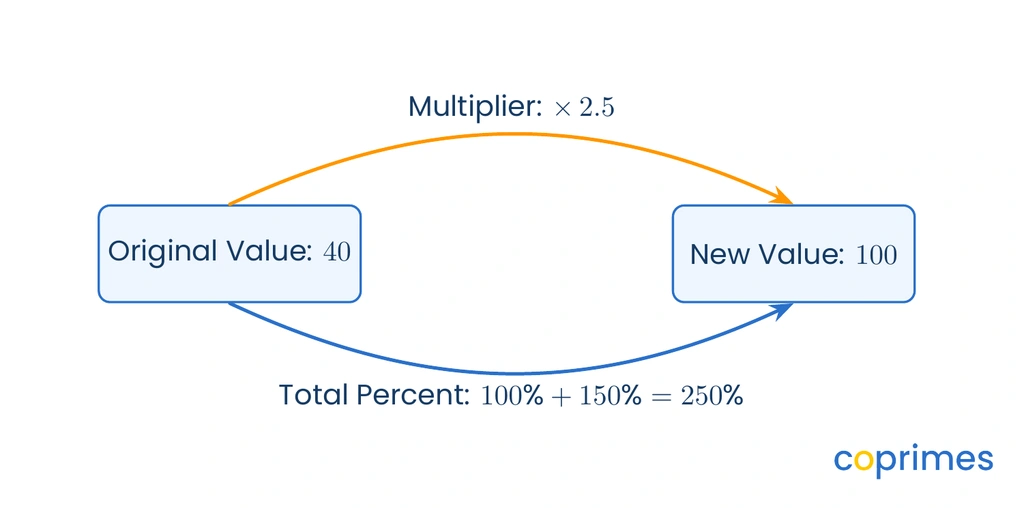
Because the starting value is always , increasing it means you add the increase percentage directly to .
To apply a percent multiplier:
- Add the percentage increase to to find the total percentage.
- Convert this total percentage into a decimal by dividing by .
- Multiply the original value by this decimal multiplier.
Calculate percentage increase between two values
When you know both the starting value and the final value, you can calculate the percent change.
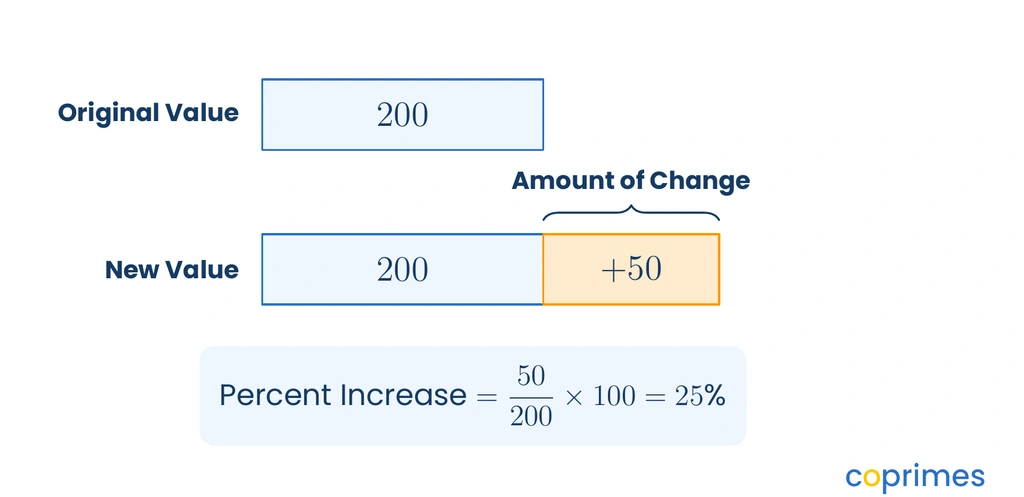
This tells you what percentage the original amount grew by. You must compare the difference between the two values strictly against the original value.
The percent increase formula is:
To use this formula, first find the amount of change by subtracting. Then, divide that difference by the starting amount and multiply by .
Worked examples
These examples show how to apply both the addition method and the multiplier method to different scenarios.
Example 1: Using a benchmark increase
Question: A library has books. The librarian plans to increase the collection by . How many books will the library have after the increase?
Method:
- Find of by dividing by . This gives .
- Find by halving the amount. This gives .
- Add the and amounts together to find the increase amount: .
- Add this increase to the original number of books: .
Answer: The library will have books.
Check: Calculate of by multiplying . Adding to confirms the result.
Example 2: Using a decimal percentage multiplier
Question: The price of a plane ticket is dollars. The airline increases the price by . What is the new price of the ticket?
Method:
- Identify the original price as .
- Add the percentage increase to find the total percentage: .
- Convert the total percentage to a decimal by dividing by : .
- Multiply the original price by the decimal multiplier: .
Answer: The new price of the ticket is dollars.
Check: Find the increase amount first: . Add this to the original price: . The answer matches.
Example 3: Calculating percentage increase between two values
Question: A farmer harvests kilograms of apples in one year. The next year, the harvest increases to kilograms. What is the percent increase in the harvest?
Method:
- Find the amount of change by subtracting the original value from the new value: .
- Divide the change by the original value: .
- Simplify the fraction or convert it to a decimal: .
- Multiply by to write the decimal as a percent: .
Answer: The harvest increased by .
Check: Increase by using a multiplier: . The result matches the new harvest amount.

Common mistakes
Watch out for these frequent errors when working with percentages.
Dividing by the wrong denominator
When calculating the percent change between two numbers, always divide the amount of change by the original, starting value. A common mistake is dividing by the new value instead, which calculates a percent decrease from the end point rather than the increase from the start.
Incorrectly converting percentages to decimals
Be careful when converting single-digit and decimal percentages into multipliers. You must divide the percentage by . For example, an increase of means adding , not . Adding would incorrectly represent a increase.
Believing percentages cannot exceed
It is perfectly valid for a value to increase by more than . For example, if a population doubles, it has increased by exactly . If it triples, it has increased by . The mathematics is identical regardless of how large the percentage becomes. You will also use these same skills when solving reverse percentages problems.
Frequently asked questions
Can finding the percent change give you a negative number?
If a value goes down instead of up, subtracting the original value from the new value produces a negative number. This negative sign simply indicates a decrease rather than an increase. In practice, you use the absolute difference and call the final positive result a percent decrease.
How do I calculate an increase involving decimal percentages?
To handle a decimal percentage like , the process does not change. Add it to to get . When you divide by to create the decimal multiplier, the decimal point moves two places to the left, yielding .
Practice questions
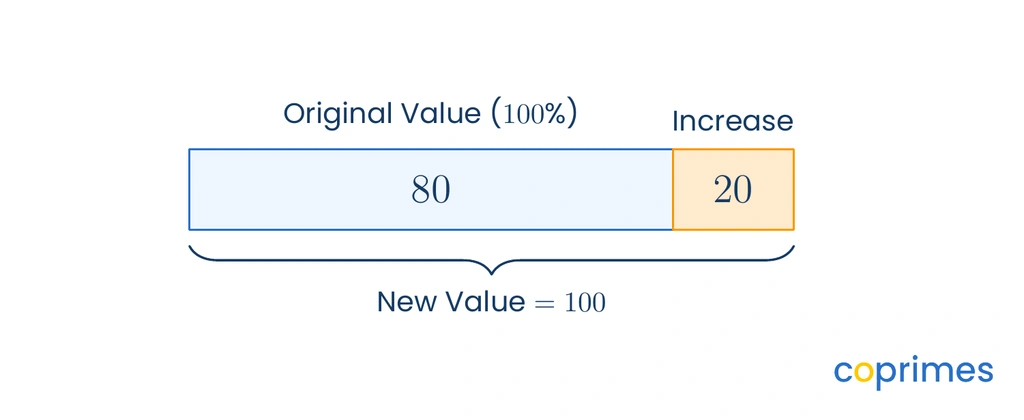
Based on the bar model shown, what is the percent increase from the original value?
What is the final value when is increased by ?
Which mathematical expression correctly calculates an increase of on an original value of ?
A town's population grew from to . What is the percent increase in the population?
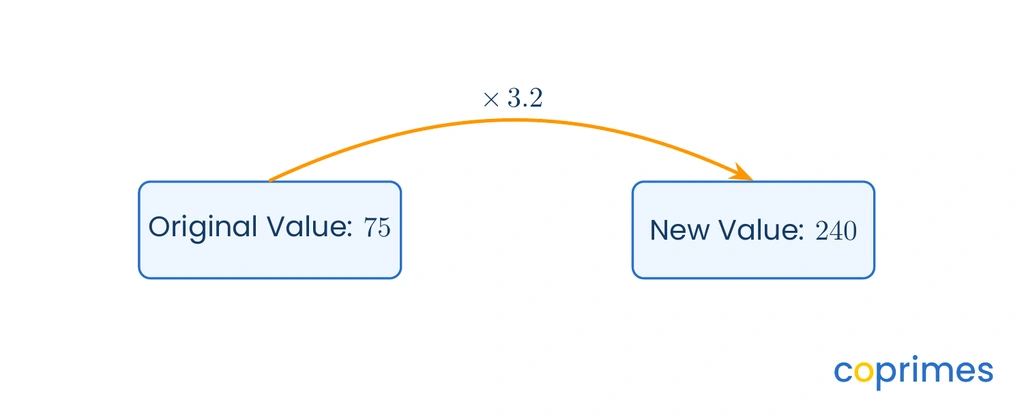
Multiplying a value by represents a percent increase. What is the percentage increase?