
Scale Drawings: Definition, Methods, and Examples
A scale drawing represents a real object at a different size while preserving its proportions. Convert measurements to compatible units, use the stated scale consistently, and label the final answer with the requested drawing or actual unit.
Scale drawings are essential in architecture, engineering, mapmaking, and science to represent objects that are too large or too small to be drawn at their true size.
What is a scale drawing?
A scale drawing is an accurate two-dimensional representation of an object where all lengths have been reduced or enlarged by a constant multiplier.
Because every length changes by the exact same ratio, the drawing maintains the true shape and proportion of the original object. The angles in a scale drawing are identical to the angles in the real object.
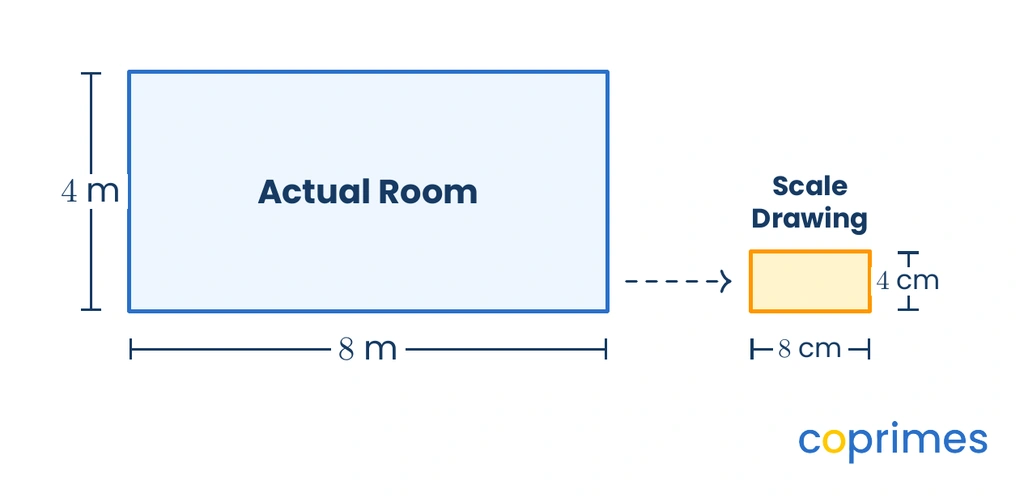
When a map, architectural blueprint, or scientific diagram is created, a scale must be chosen. This scale dictates exactly how lengths translate between the paper and the real world.
Read drawing-to-actual scales
A scale describes the relationship between a distance on the drawing and the corresponding distance in reality. This relationship is a central application of scale in math.
Scales are presented in two main formats: with units and without units.
Scales with units
A scale with units states exactly what one measurement on paper represents in reality. For example, a scale of means every centimeter measured on the drawing represents meters in the real world.
Scales without units (Ratios)
A ratio scale, such as , does not specify units. Instead, it means that unit of measurement on the drawing represents of those same units in reality.
In a unitless ratio, you can choose any unit as long as you use it for both numbers.
If a map uses a scale, then on the map represents in the real world, and on the map represents in the real world.
Find an actual distance
To find a real-world distance from a scale drawing, multiply the drawing distance by the scale factor.
If the scale states , and the drawing distance is , multiply the drawing distance by .
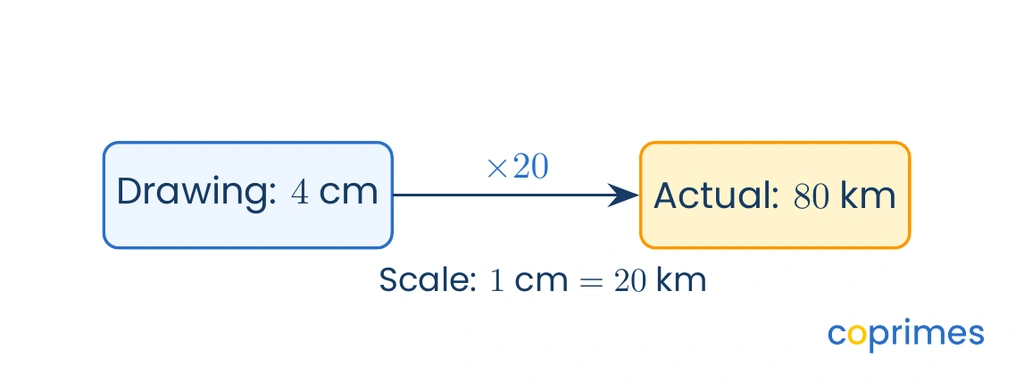
Using equivalent ratios is a reliable method for structuring these calculations. Setting up a ratio table ensures that the relationship remains balanced between the drawing and the real world.

Find a drawing distance
To find how long a line should be on a scale drawing, divide the real-world distance by the scale factor.
If a real park measures across, and the scale is , divide the real measurement by to determine the size of the drawing.
The drawing distance must be . When creating the drawing, verify that the units used match the units stated in the scale.
Convert units before scaling
When using a unitless ratio scale, it is often necessary to convert measurements into compatible units before multiplying or dividing.
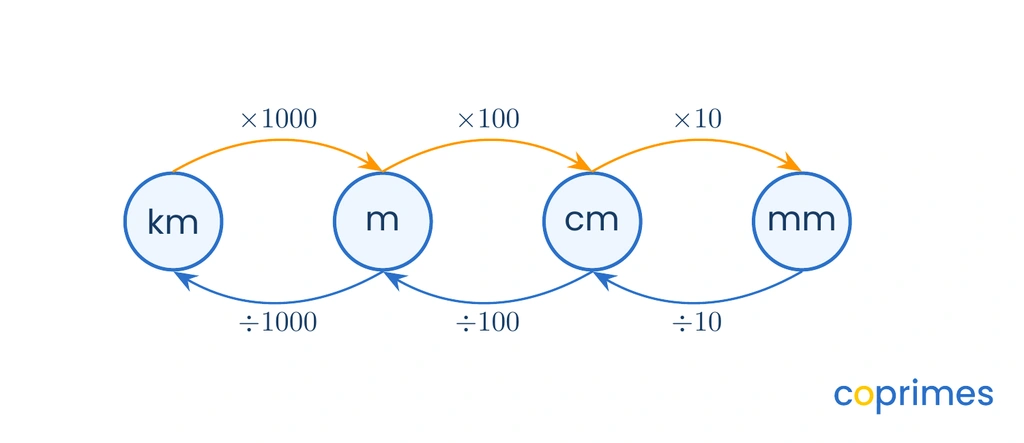
If a map uses a scale, and two points are apart on the paper, the actual distance is . While correct, is difficult to visualize. Converting to meters or kilometers provides a more practical answer.
The actual distance is . It is standard practice to present real-world distances in meters or kilometers, and drawing distances in centimeters or millimeters.
Worked examples
Example 1: Finding an actual distance
Question: A map has a scale of . The distance between two cities on the map is . What is the actual distance between the cities?
Method:
- Identify the drawing distance: .
- Identify the scale factor: Each centimeter represents .
- Multiply the drawing distance by the scale factor: .
Answer: The actual distance is .
Check: Use proportional reasoning. Since is , is , and half a centimeter is . Adding these gives .
Example 2: Finding a drawing distance
Question: A building is tall. An architect creates a drawing of the building using a scale of . How tall will the building be in the drawing?
Method:
- Identify the actual distance: .
- Identify the scale factor: Every in reality becomes on the drawing.
- Divide the actual height by the scale factor: .
Answer: The drawing height will be .
Check: Multiply the drawing distance by the scale factor using ratio tables to verify. , which matches the original height.
Example 3: Unit conversion before scaling
Question: A real bridge is long. An engineer builds a model using a ratio scale. How long is the model bridge in centimeters?
Method:
- Convert the actual length into centimeters so it is easier to divide. First, convert kilometers to meters: .
- Convert meters to centimeters: .
- Divide the actual length in centimeters by the scale ratio: .
Answer: The model bridge is long.
Check: This calculation requires multi-step ratio problem solving. Working backward, , which converts back to .
A learning plan shaped by your child, not the class
State-aligned Math plus our own Logic and English curriculum. An adaptive baseline test finds the gaps and fills them.
Common mistakes
Applying the scale backward
A frequent error is multiplying when finding a drawing distance or dividing when finding an actual distance. Always remember that real-world measurements are usually much larger than paper measurements (unless the scale represents microscopic objects). If the result does not make logical sense for the context, check the operation.
Forgetting to convert units
When working with unitless scales like , do not divide an actual measurement in meters and assume the answer is in centimeters. The calculation maintains the same unit. An actual measurement of divided by a scale factor of gives a drawing distance of , which must then be converted to .
Frequently asked questions
Are scale drawings always smaller than the real object?
No. While maps and floor plans are scaled down, scientific drawings of tiny objects are scaled up. For example, a drawing of an insect might use a scale of , meaning on the paper represents only in reality.
What does a scale mean?
A scale means the drawing is exactly the same size as the real object. One unit on the paper represents exactly one unit in reality.
Practice questions
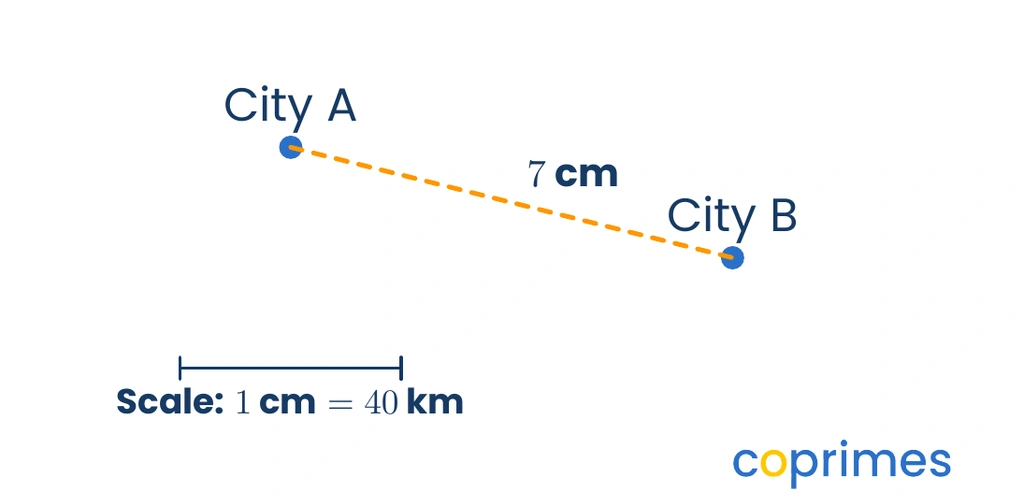
Based on the map above, what is the actual distance between City A and City B?
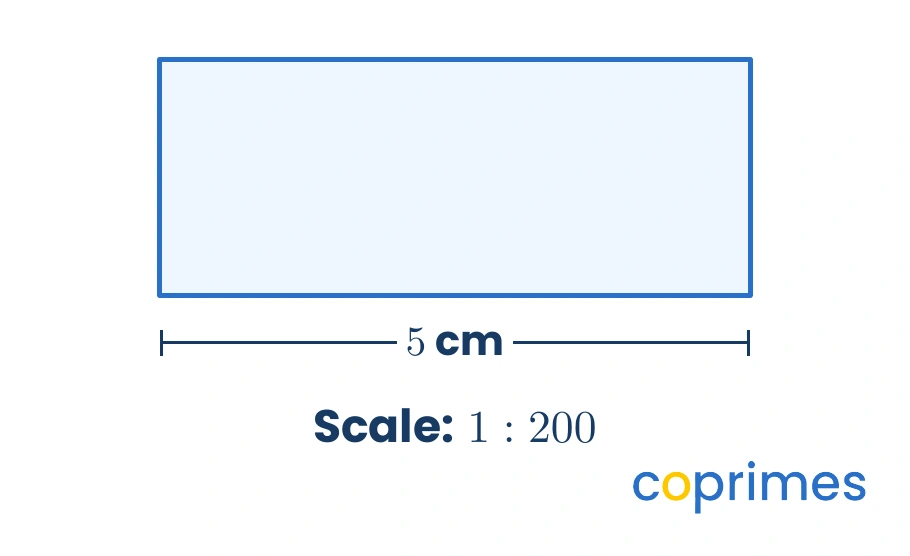
A floor plan has a unitless scale of . What is the actual width of the room in meters?
An actual insect is long. A scientific drawing uses an enlargement scale of . What is the length of the insect in the drawing?
A map states its scale is . Which of the following unitless ratios represents the same scale?
A real truck is long. A model of the truck is built to a scale. What is the length of the model in centimeters?