
Simplifying Ratios: Definition, Method and Examples
Simplify a ratio by dividing every term by their greatest common factor. This keeps the multiplicative relationship the same while writing it with the smallest whole-number terms possible.
What does simplifying a ratio mean?
A ratio compares the size of two or more quantities. When you simplify a ratio, you write it in its lowest terms so that the numbers share no common factors other than .
Simplifying does not change the mathematical relationship. Instead, it creates equivalent ratios that are easier to understand and work with. You can represent this visually using a bar model. For example, grouping shares equally shows why the ratio simplifies to .
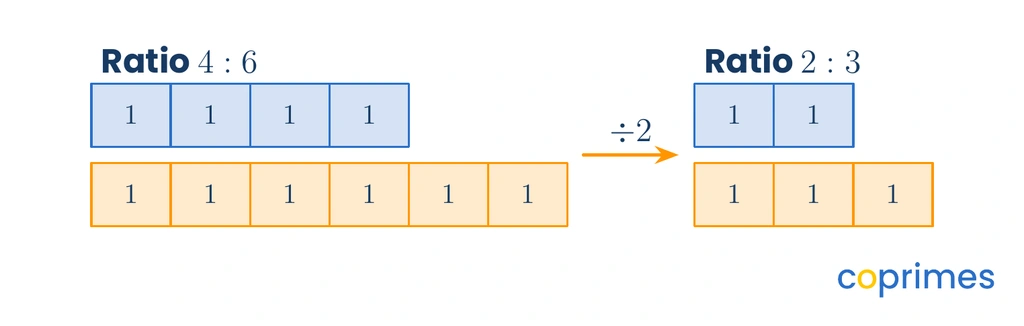
Find a common factor
To simplify a ratio, you must divide both sides by the same whole number. You can start by identifying any common factor shared by the terms.
If the terms are large, you can reduce ratios by dividing by smaller numbers in multiple steps. For instance, you could simplify by first dividing by to get , and then dividing by to reach .
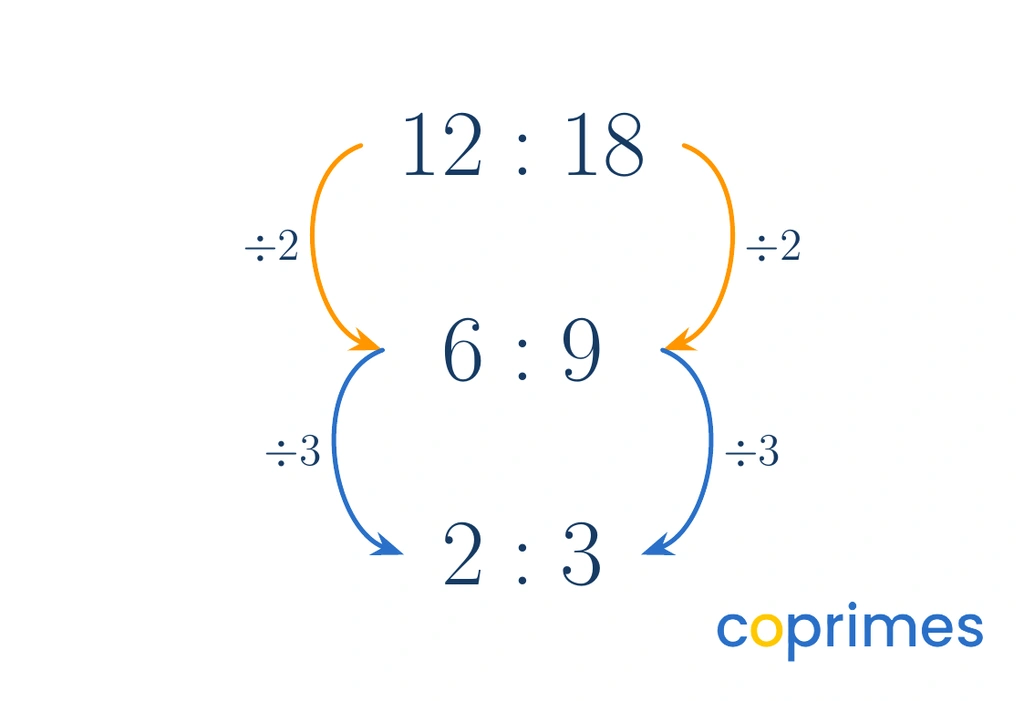
This step-by-step approach always works, but you must keep dividing until no common factors remain.
Use the greatest common factor
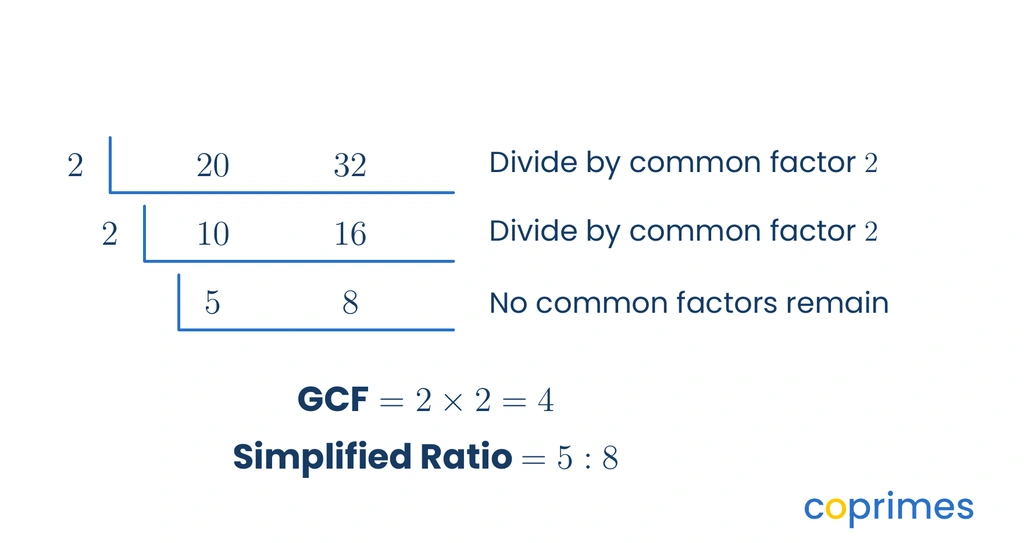
You can simplify any ratio in a single step by dividing its terms by their greatest common factor (GCF). The GCF is the largest whole number that divides exactly into all parts of the ratio.
For example, to simplify :
- List the factors of : .
- List the factors of : .
- Identify the GCF: .
- Divide both terms by to find the simplest ratio.
Alternatively, you can use a GCF ladder or prime factorization to find the common factor systematically.
A learning plan shaped by your child, not the class
State-aligned Math plus our own Logic and English curriculum. An adaptive baseline test finds the gaps and fills them.
Simplify ratios with more than two terms
Ratios can compare three or more parts at once. The rule for simplifying a three-term ratio is exactly the same: you must divide every term by the GCF shared by all of them.
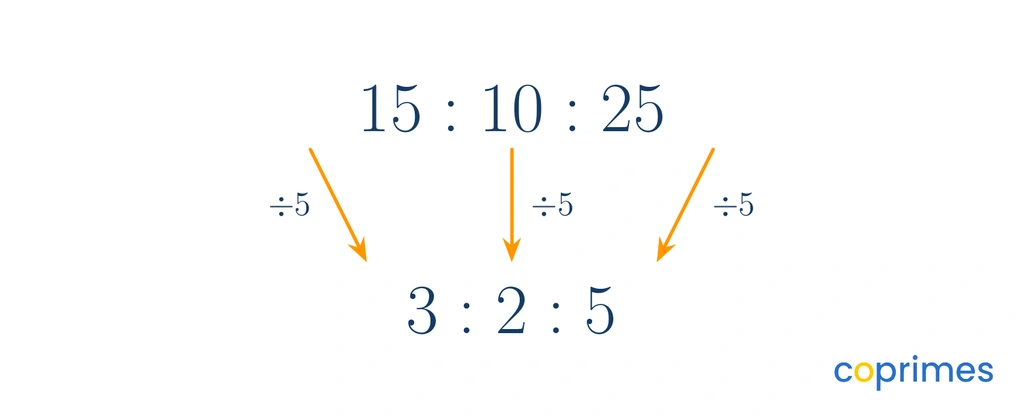
If you find a common factor that works for two terms but not the third, you cannot use it. All terms in the ratio must be divisible by the chosen factor.
Handle ratios with units
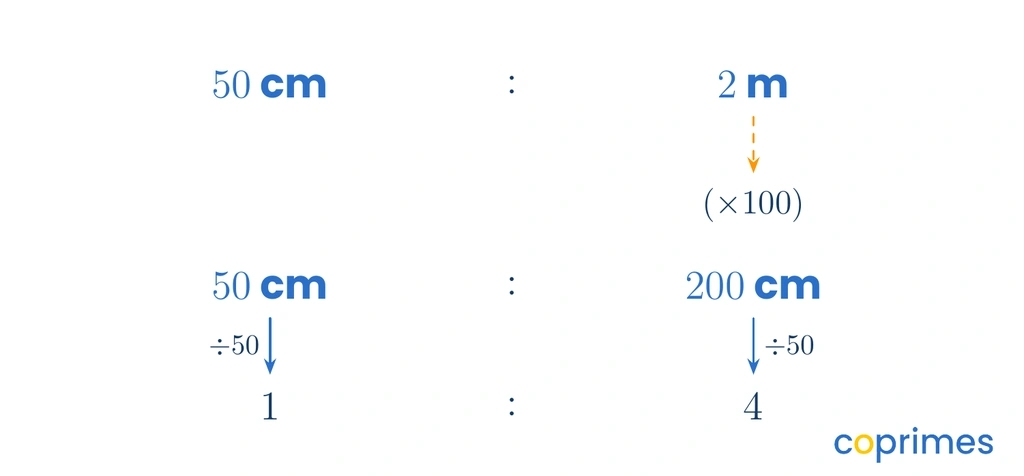
When a ratio compares measurements, the units must be identical before you can simplify or write the final ratio. If the units differ, convert the larger unit into the smaller unit first.
For example, to find the ratio of to :
- Convert to .
- Write the ratio in the same units: .
- Divide both parts by the GCF of .
Worked examples
Example 1: Simplifying a two-term ratio
Question: Write the ratio in simplest form.
Method:
- Find the GCF of and .
- The factors of are .
- The factors of are .
- The GCF is .
- Divide both parts of the ratio by .
Answer: .
Check: Multiply and by to ensure you return to and .
Example 2: Simplifying a three-term ratio
Question: Simplify the ratio .
Method:
- Identify the GCF for all three numbers.
- The numbers , , and share the GCF of .
- Divide every term by .
- .
- .
- .
Answer: .
Check: Ensure no common factor remains among , , and . The only common factor is , so it is fully simplified.
Example 3: Simplifying with different units
Question: Write the ratio of to in simplest form.
Method:
- Convert the larger unit (hours) into the smaller unit (minutes).
- .
- Write the ratio using the common unit: .
- Find the GCF of and , which is .
- Divide both terms by .
Answer: .
Check: Since is exactly one-third of , the ratio is correct.

Common mistakes
Using subtraction instead of division
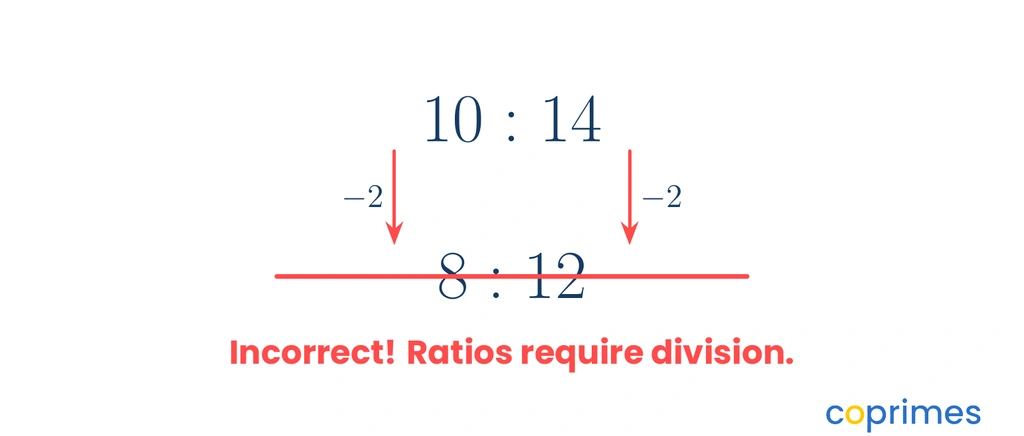
A ratio represents a multiplicative relationship. You can only simplify by dividing (or multiplying) all terms by the same number. If you subtract the same number from every term, you break the proportion and create an incorrect ratio.
Not fully simplifying
If you divide by a common factor that is not the GCF, the ratio will become smaller, but it will not be in ratio lowest terms. Always check your final answer to see if another common factor exists. Similar reasoning applies when finding equivalent fractions.
Leaving decimals in a simplified ratio
A fully simplified ratio should only contain whole numbers. If you have a ratio like , multiply both sides by to remove the decimal, resulting in the whole-number ratio .
Frequently asked questions
What does it mean if the greatest common factor is ?
If the GCF of the terms is , they share no other factors. This means the ratio is already in simplest form and cannot be reduced further.
Can you write a ratio as a fraction?
Yes, a two-term ratio can be written as a fraction where the first term is the numerator and the second term is the denominator. Simplifying a ratio uses the same mathematical rules as simplifying a fraction.
What is the highest common factor?
The highest common factor (HCF) is another term for the greatest common factor (GCF). They refer to exactly the same mathematical concept.
How do I apply these skills next?
Once you are confident with simplifying, you can build ratio tables to solve proportion problems and scale mixtures up or down efficiently.
Practice questions
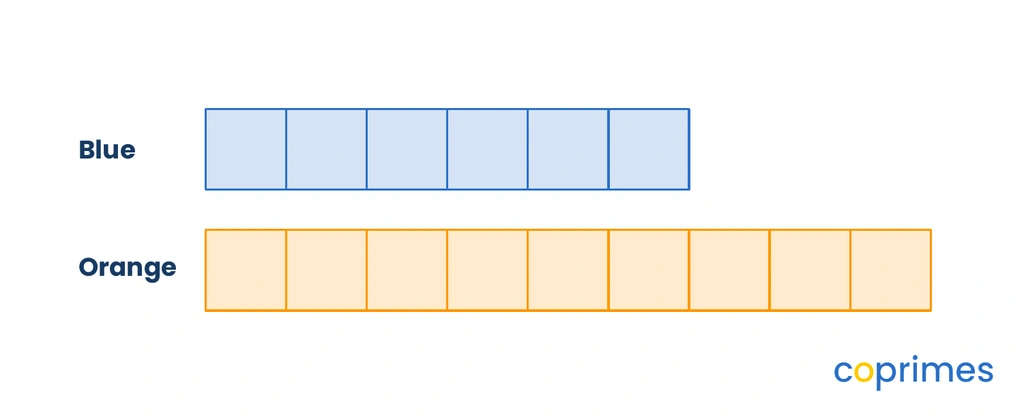
The bar model shows blue squares and orange squares grouped equally. Which ratio represents this relationship in simplest form?
Simplify the ratio .
Simplify the ratio .
A student attempts to simplify the ratio by subtracting from both sides, resulting in . Why is this incorrect?
The student subtracted instead of dividing by a common factor.
The student should have subtracted from both sides instead.
The student divided by instead of .
The ratio is fully simplified, so the student is actually correct.
The student subtracted instead of dividing by a common factor.
Write the ratio of to in simplest form.