
Adding Fractions: Definition, Method and Examples
To add fractions, first make the denominators the same when needed by writing equivalent fractions. Then add the numerators, keep the common denominator, and simplify the result when possible.
How do you add fractions?
Fractions represent parts of a whole. Adding them means combining those parts into a single total.
To perform fraction addition successfully, the sizes of the pieces being combined must be identical. The denominator, which is the bottom number, tells you the size of the parts. The numerator, which is the top number, tells you how many parts you have. If the denominators are not identical, you must find a common denominator before you can calculate the sum of fractions.
Always make the denominators identical before adding fractions.
Add fractions with the same denominator
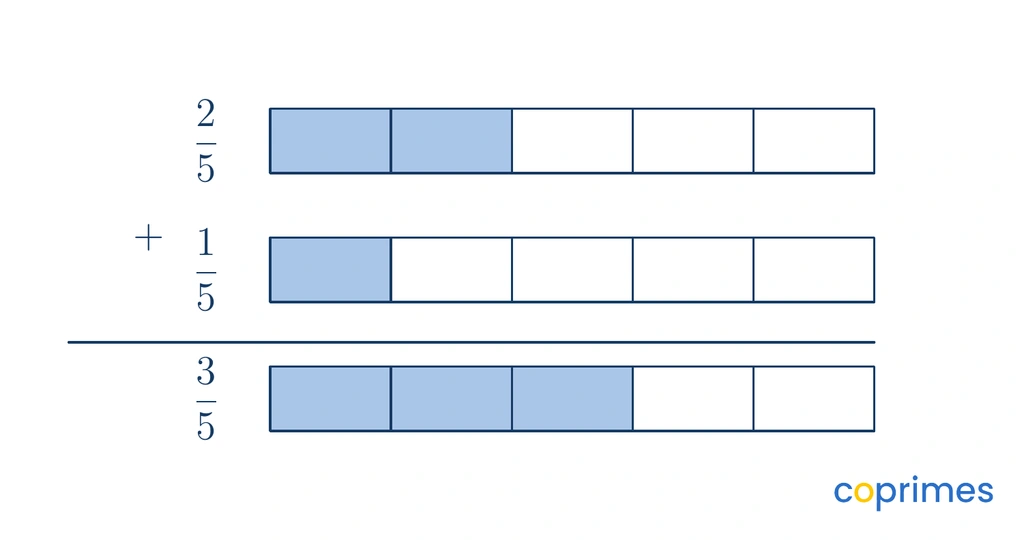
When fractions have the same denominator, they are called like fractions. Because their parts are exactly the same size, you can add them by simply counting the total number of parts.
Method:
- Verify that the denominators are identical.
- Add the numerators together to find the new numerator.
- Keep the denominator exactly the same.
Add fractions with different denominators
Fractions with different denominators are called unlike fractions. You cannot add unlike fractions directly because their parts represent different sizes.
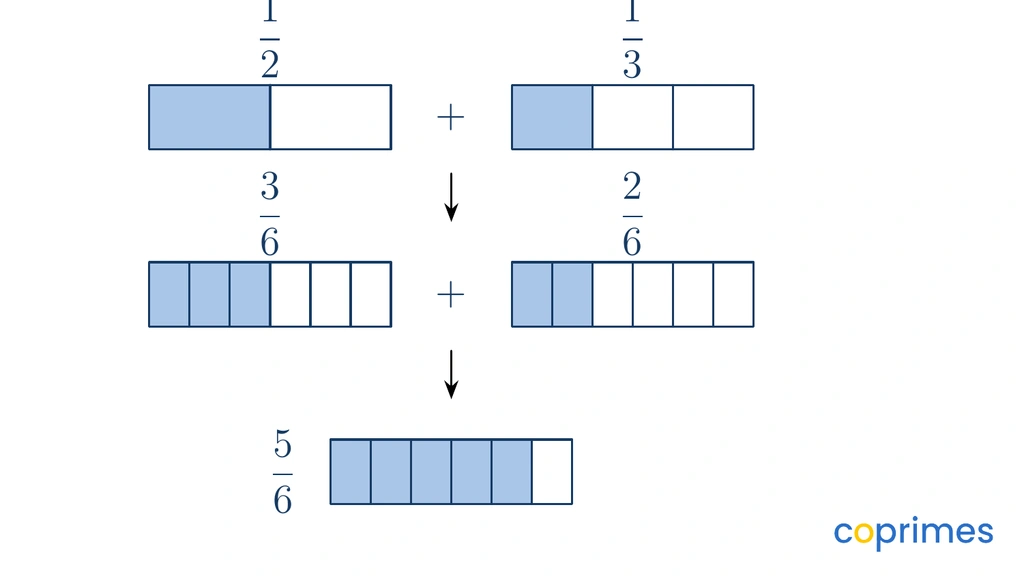
To combine them, you must rewrite the fractions so they share the exact same denominator.
Method:
- Find the lowest common multiple of the two denominators. This multiple becomes the new common denominator.
- Multiply the numerator and denominator of each fraction by the required factor to create an equivalent fraction.
- Add the numerators of the matching fractions together and keep the common denominator.

Add fractions and whole numbers
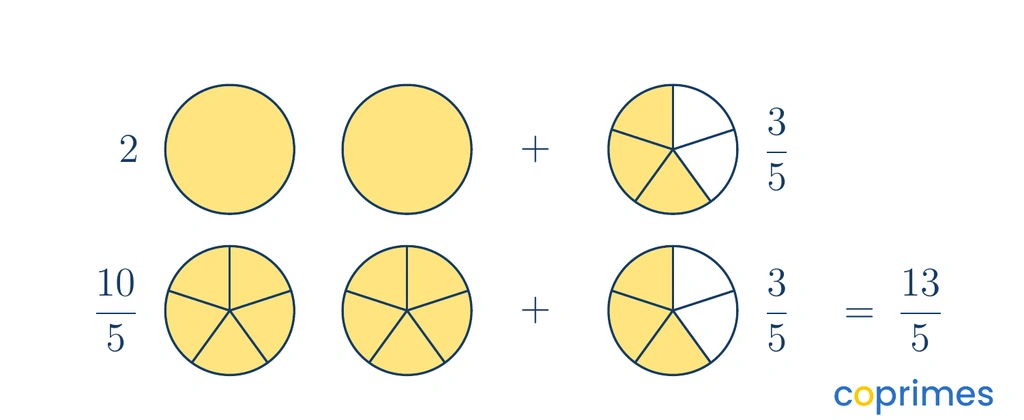
To add a whole number and a proper fraction, you can easily combine them into a single mixed number. For example, immediately becomes .
However, during multi-step calculations, it is often necessary to combine them into a single improper fraction instead.
Method:
- Rewrite the whole number as a fraction by giving it a denominator of .
- Find a common denominator for both fractions.
- Convert the whole number fraction to an equivalent fraction.
- Add the numerators together and keep the denominator.
Check and simplify the sum
After adding fractions, the result may not be in its simplest form. Practicing simplifying fractions makes the final answer much easier to understand and use in further calculations.
To simplify a fraction, find the greatest common factor of the numerator and the denominator. Divide both the top and the bottom number by this common factor.
For example, if your sum is , the greatest common factor of and is . Divide both the numerator and denominator by to reach the simplified answer, .
Visual worked examples
Practicing different types of addition problems helps reinforce the steps, especially when applying them to fraction word problems.
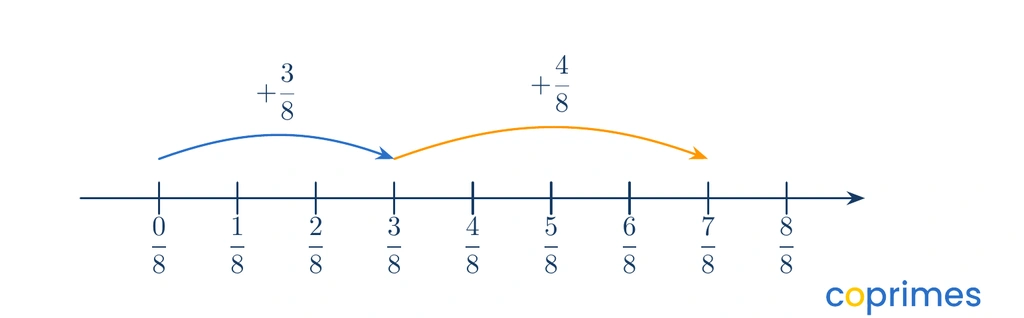
Example 1: Adding fractions with identical denominators
Question: What is ?
Method:
- Check that both fractions share the denominator .
- Add the numerators together: .
- Keep the denominator exactly the same.
Answer:
Check: The denominator correctly remained , and the numerator represents the total number of parts.
Example 2: Adding fractions with different denominators
Question: Calculate .
Method:
- Find the lowest common multiple of and , which is .
- Convert to the equivalent fraction .
- Convert to the equivalent fraction .
- Add the numerators: .
Answer:
Check: Verify that is a valid multiple of both and , and check the numerator addition.
Example 3: Sum greater than one
Question: Calculate .
Method:
- Find the lowest common multiple of and , which is .
- Multiply the first fraction by to reach .
- Multiply the second fraction by to reach .
- Add the new numerators: .
- Keep the denominator .
Answer:
Check: Estimate the final sum. Both original fractions are larger than one half, so the total sum must naturally be greater than one whole.
A learning plan shaped by your child, not the class
State-aligned Math plus our own Logic and English curriculum. An adaptive baseline test finds the gaps and fills them.
Common mistakes
The most frequent error when adding fractions is adding both the numerators and the denominators together simultaneously.
For example, a student might incorrectly calculate . This is mathematically false. The fraction is merely equivalent to . If you combine one half of a shape with another half of a shape, you build one complete shape, not another half.
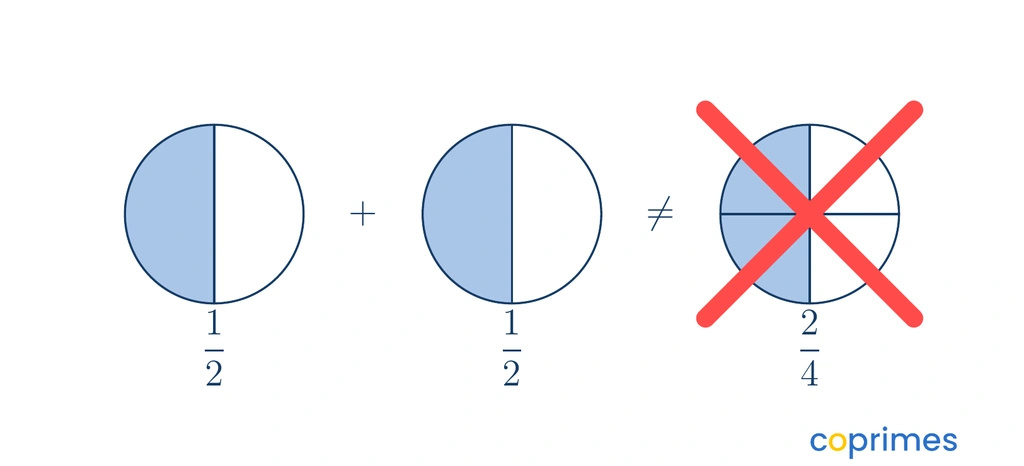
The denominator represents the fixed size of the piece, which never changes when you combine identical pieces.
Never add the denominators together.
Frequently asked questions
How do I add three fractions together?
Find the least common multiple for all three denominators first. Convert all three original fractions into equivalent fractions using this shared denominator, then simply add all three numerators together.
How do I add mixed numbers?
You can efficiently convert each mixed number into an improper fraction first, then add them using the standard rules. This technique provides the foundation for correctly adding and subtracting mixed numbers.
Are the rules for subtracting fractions the same?
Yes. When subtracting fractions, you must also secure a common denominator before you subtract the numerators. The common denominator remains perfectly unchanged throughout the calculation.
Practice questions

Which addition sentence does the fraction strip model?
Which pair of equivalent fractions should be used to calculate ?
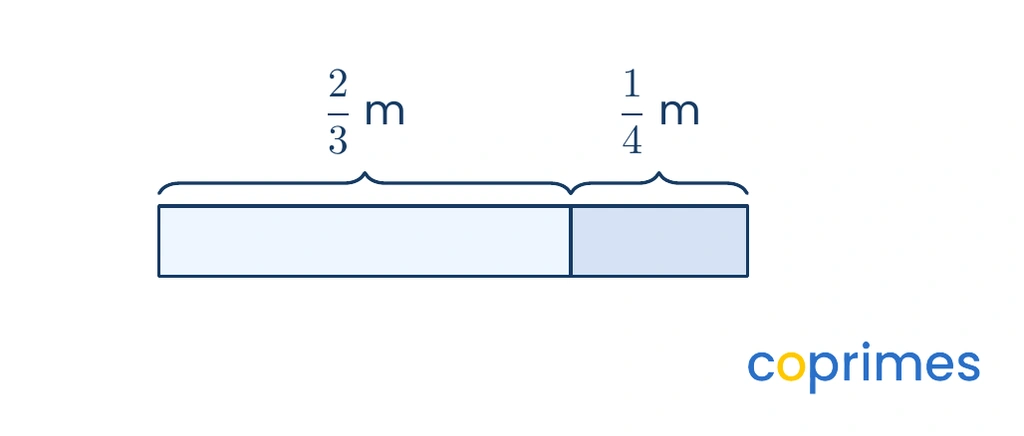
What is the total length of the connected pipes, in meters?
A student mistakenly calculated . What error did they make?
They added the denominators instead of keeping them the same.
They should have subtracted the numerators instead.
They forgot to find a common denominator first.
They simplified the resulting fraction incorrectly.
They added the denominators instead of keeping them the same.
A baker mixes cups of flour and cup of cocoa powder. What is the total amount of the mixture, written as an improper fraction?