
Multiplying Fractions by Whole Numbers: Definition, Method, and Examples
To multiply a fraction by a whole number, interpret the whole number as repeated groups or write it over , multiply, and simplify; the result may be a fraction, whole number, or mixed number. This process scales the fraction and provides a strong foundation for all further work in multiplying fractions.
What does a whole number times a fraction mean?
Multiplying a whole number by a fraction means combining equal-sized fractional parts. Just as multiplying whole numbers represents repeated addition, multiplying by a fraction represents a specific number of equal fractional pieces.
For example, means adding three times. This is equivalent to finding the total size of groups, each having a size of .
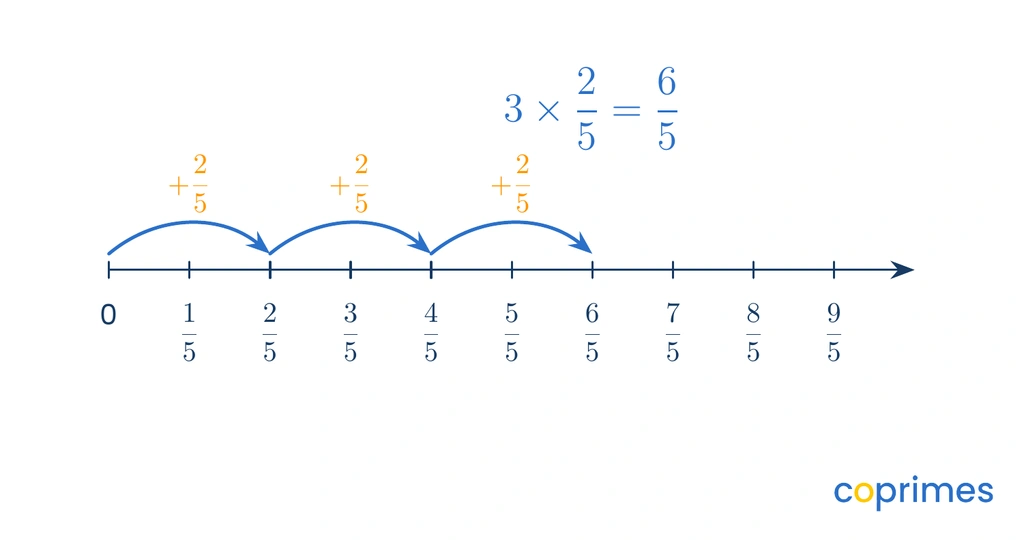
Using repeated addition, we write .
This idea builds upon unit fractions, where a non-unit fraction like is created by multiplying by the unit fraction .
Use repeated groups
Visualizing a multiplication sentence as repeated groups helps clarify the relationship. The whole number tells us the number of groups, and the fraction tells us the size of each group.
When we calculate , we picture distinct groups, where each group contains one-third of a whole shape.
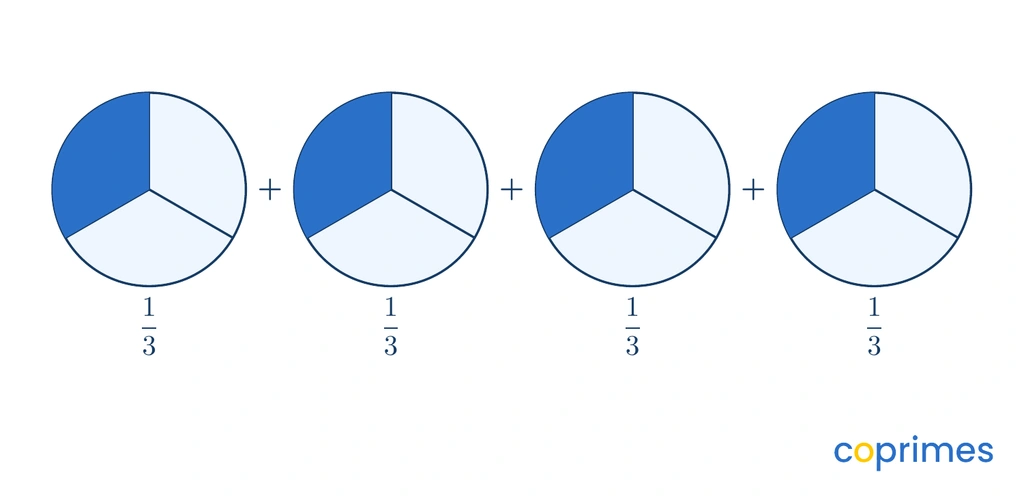
By counting the shaded pieces, we see there are shaded thirds in total. Combining them creates the improper fraction .
This visual method is highly effective for smaller numbers, but a numerical method is necessary for larger values.
Write the whole number over one
The most efficient numerical method for multiplying a fraction by a whole number is to express the whole number as a fraction with a denominator of .
Every whole number can be written over without changing its value. For instance, is the same as .
Convert the whole number to a fraction, multiply straight across, and simplify.
Here are the standard steps for this method:
- Write the whole number as a fraction by placing it over .
- Multiply the numerators together to find the new numerator.
- Multiply the denominators together to find the new denominator.
- Simplify the resulting fraction if possible.
If we multiply by , we first rewrite as .
We multiply the numerators to get .
We multiply the denominators to get .
The result is , which simplifies to when we divide the top and bottom by their greatest common factor, .
A learning plan shaped by your child, not the class
State-aligned Math plus our own Logic and English curriculum. An adaptive baseline test finds the gaps and fills them.
Find a fraction of a quantity
Multiplying by a whole number is also used to find a fraction of a specific amount. The word "of" in mathematics frequently translates to multiplication.
When you need to find of , you are calculating .
To do this visually, we arrange the items into equal groups to find one-third. Then, we select of those groups to find two-thirds.
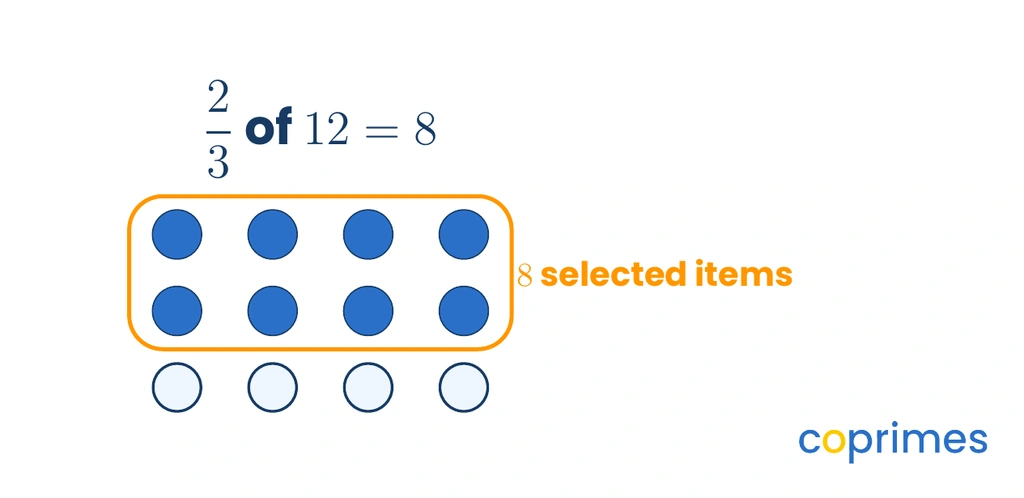
This model confirms that . Working with fractions of a whole and a set demonstrates how fractional parts relate to real-world collections.
Interpret products greater than one
When we multiply a whole number by a proper fraction, the answer is often an improper fraction—a fraction where the numerator is larger than or equal to the denominator.
Improper fractions represent values greater than or equal to . We often convert these results into mixed numbers for better understanding, which prepares learners for multiplying mixed numbers in future lessons.
To convert an improper fraction to a mixed number, divide the numerator by the denominator. The quotient becomes the whole number part, and the remainder forms the numerator of the proper fraction part.
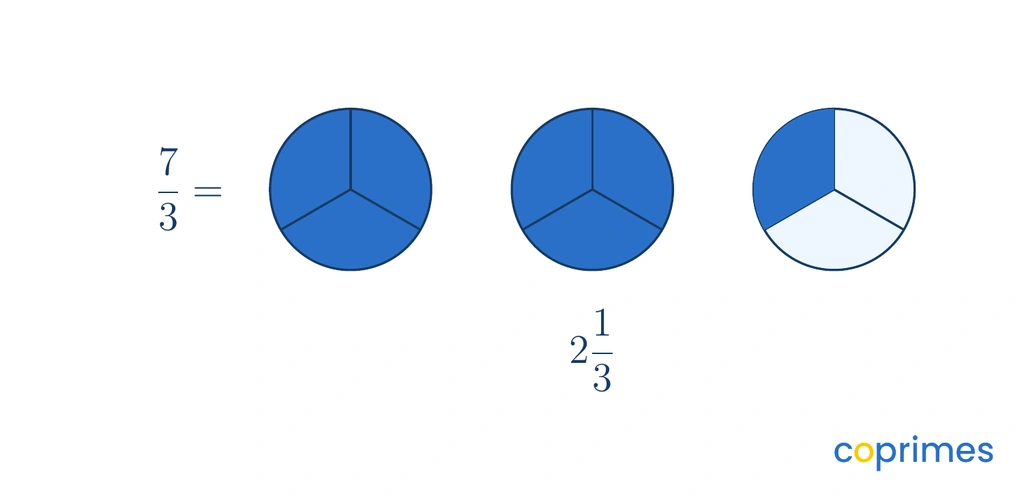
For example, divides by to give with a remainder of . The answer is written as .
Visual worked examples
The examples below illustrate how to apply the multiplication method, handle discrete quantities, and simplify fractions. Understanding these procedures is essential for solving fraction word problems.
Example 1: Multiplying a whole number by a proper fraction
Question: What is ?
Method:
- Rewrite the whole number as a fraction over .
- Multiply the numerators together and the denominators together.
- Convert the resulting improper fraction to a mixed number.
Answer: First, . Since with a remainder of , the final mixed number is .
Check: Visualize five groups of three-fourths. fourths in total. Grouping four fourths into a whole gives wholes and remaining fourths.
Example 2: Finding a fraction of a discrete quantity
Question: What is of ?
Method:
- Translate the word "of" to multiplication.
- Rewrite as .
- Multiply and simplify by dividing the numerator and denominator by a common factor.
Answer: Calculating gives . Dividing by gives exactly .
Check: Divide items into groups. Each group has items. Taking of those groups gives .
Example 3: Multiplying with simplification
Question: Calculate .
Method:
- Write over .
- Multiply the numerators and denominators.
- Simplify the fraction by dividing by the greatest common factor.
Answer: The multiplication equals . Both and share a common factor of
, which simplifies the result to . Converting this to a mixed number gives .
Check: Simplify and before multiplying. Divide both by to get and . Then, multiply to get .

Common mistakes
When mastering fraction multiplication, a few common errors can lead to incorrect answers. Recognizing them helps build accuracy.
- Multiplying the whole number by the denominator: Some learners incorrectly multiply the whole number by both the numerator and the denominator, or just the denominator. For example, computing as . This is incorrect because means . Always write the whole number over before multiplying straight across.
- Adding instead of multiplying: Because whole numbers require a common denominator during addition, some learners mistakenly look for common denominators during multiplication. Multiplication does not require common denominators.
- Leaving improper fractions unsimplified: While an improper fraction is mathematically correct, many problems ask for the simplest form or a mixed number. Always check if the numerator and denominator share a common factor.
Frequently asked questions
Does the order of multiplication matter?
No, the order does not matter. The commutative property applies to fractions just as it does to whole numbers. Therefore, produces exactly the same result as .
Do you need a common denominator to multiply a whole number by a fraction?
No, common denominators are only required for adding and subtracting fractions. When multiplying, simply express the whole number as a fraction over and multiply the numerators and denominators straight across.
Why does multiplying a whole number by a proper fraction make it smaller?
When you multiply a whole number by a proper fraction, you are taking a part of that whole number. Because a proper fraction is less than , the result will always be less than the original whole number. For instance, of is .
Practice questions
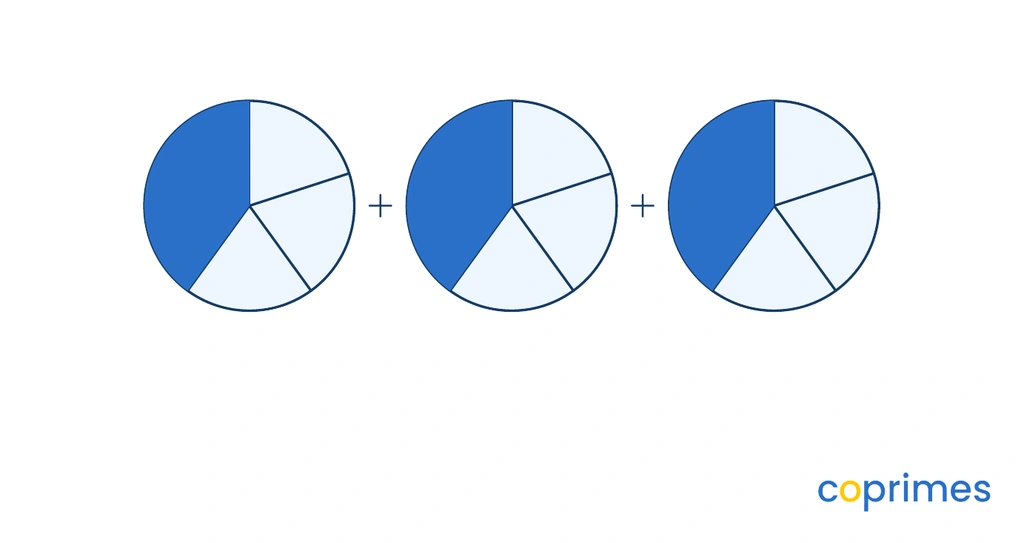
Which multiplication sentence correctly represents the shaded model?
Calculate and state the answer in its simplest form.
A recipe requires of a cup of sugar for one batch of cookies. If a baker makes batches, how many cups of sugar are needed?
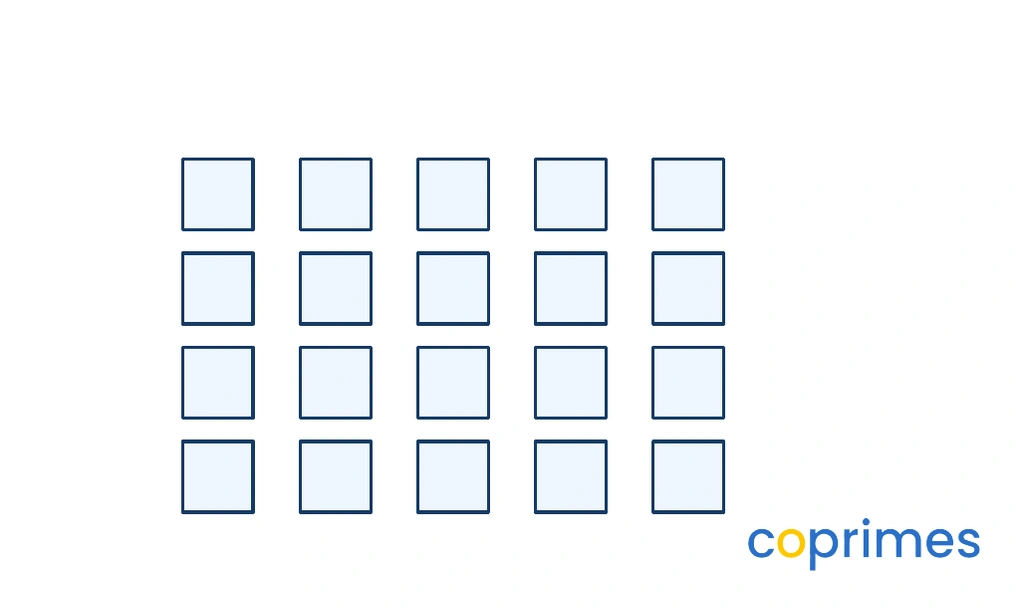
A teacher arranges desks into an array. If of the desks are used for an exam, how many desks is that?
Which of the following shows the correct procedure and answer for ?